
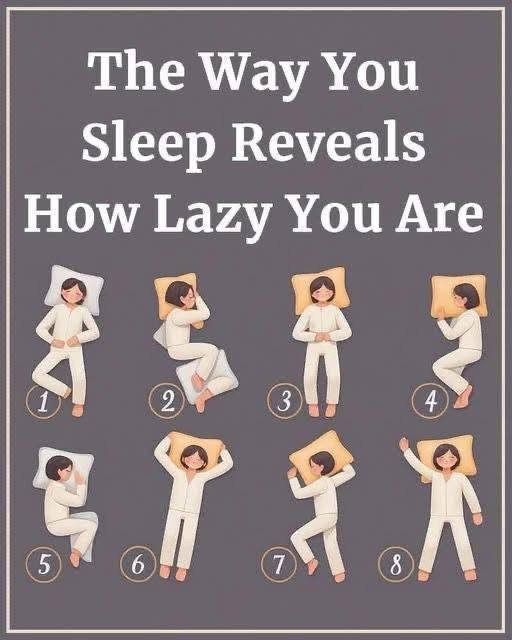
🥱🛌 What Your Sleeping Position Really Says About You (Myths vs Reality)
Sleep is one of the most personal and unconscious behaviors we have. Every night, without thinking about it, we settle into a position that feels natural, comfortable, and sometimes even comforting in a psychological sense. Because of this, people have long tried to “decode” sleeping positions as if they reveal hidden traits—personality, habits, and even levels of energy or motivation.
One popular internet claim is that your sleeping position reveals how “lazy” you are. But does science actually support that? Or is it just another oversimplified myth designed to go viral?
Let’s break it down properly—no judgment, no labels, just understanding how sleep positions actually work and what they can and cannot tell us about a person.
🧠 First Things First: Can Sleep Positions Reveal Laziness?
The short answer is: no, not really.
There is no scientific evidence linking sleep posture with laziness, motivation, or productivity in waking life. Laziness itself isn’t even a medical or sleep-related category—it’s a subjective label people use to describe behavior.
What sleep researchers do agree on is this:
Sleep positions are influenced by comfortThey
are shaped by breathing patterns
They depend on body pain or tension
They can reflect emotional stress or relaxation
They often change throughout the night
In other words, your sleeping position is more about your body’s needs than your personality traits.
So instead of judging sleep positions, it’s more useful—and more interesting—to understand what influences them.
🛌 Why You Don’t Sleep in Just One Position
If you think you sleep in a single position all night, you might be surprised.
Most people shift between 10–40 times per night, even if they don’t remember it. These movements are essential for:
Preventing stiffness
Improving circulation
Reducing pressure on joints
Regulating temperature
Your brain naturally adjusts your posture during sleep to keep your body comfortable and safe. So what you wake up in is only a snapshot, not the full story.
💤 The Most Common Sleep Positions (and What They Actually Mean)
Let’s explore the most common sleeping positions and what they are often associated with—not as personality judgments, but as general sleep behaviors.
1. 🛏️ Fetal Position (Curled on Your Side)
This is the most common sleep position worldwide.
What it looks like:
Side sleeping
Knees drawn toward the chest
Body slightly curled
Why people sleep like this:
It feels safe and comforting
Helps reduce snoring
Eases pressure on the lower back
What it might reflect (realistically):
Some studies suggest side sleeping can be linked to stress relief, since curling up is a natural protective posture. But that doesn’t mean anything negative—it simply means the body is relaxing.
Important truth:
It has nothing to do with laziness. It’s actually one of the healthiest positions for spinal alignment when done correctly.
2. 🛌 Log Position (Straight Side Sleeper)
What it looks like:
Lying on one side
Arms resting down alongside the body
Body relatively straight
Why people choose it:
Comfortable breathing
Reduces acid reflux
Good for spine alignment
What it might reflect:
People who sleep like this are often described in personality quizzes as “social” or “easy-going,” but again—this is not scientifically proven.
What is true:
This is one of the most medically recommended sleep positions, especially for digestion and heart health.
3. 🛏️ Yearner Position (Side Sleeping with Arms Extended)
What it looks like:
Side sleeping
Both arms stretched forward
Why people do it:
Helps open the chest
Can improve breathing comfort
May indicate seeking comfort or space
Reality check:
This position doesn’t reveal ambition or laziness—it simply helps some people breathe more freely or feel less restricted.
4. 💤 Soldier Position (Sleeping on the Back, Arms Down)
What it looks like:
Lying flat on the back
Arms straight at the sides
Body still and symmetrical
Why people sleep this way:
Spinal alignment
Natural rest position for some
Easy breathing for others
Possible associations:
Back sleeping is sometimes linked with discipline in pop psychology—but there is no scientific backing for that.
Real downside:
It may worsen snoring or sleep apnea in some people.
5. 🛌 Starfish Position (Back Sleeping, Arms Up)
What it looks like:
Lying on the back
Arms raised above the head or pillow
Why it happens:
Relaxed shoulder muscles
Natural comfort position
What it might actually indicate:
Nothing about personality or motivation. It’s simply a relaxed posture that reduces shoulder pressure.
6. 💤 Stomach Sleeping (Freefall Position)
What it looks like:
Lying on the stomach
Head turned sideways
Arms under pillow or nearby
Why people do it:
Can reduce snoring
May feel grounding for some people
Important note:
This position can strain the neck and spine if not supported properly.
Myth vs reality:
It is often unfairly labeled as “lazy” in internet memes—but there is absolutely no evidence for that. It’s just a less common comfort preference.
🧩 So Why Do These Myths About “Laziness” Exist?
The idea that sleep positions reflect laziness comes from a mix of:
Internet personality quizzes
Oversimplified psychology content
Viral social media posts
Human tendency to categorize behavior quickly
Our brains naturally like patterns. If someone sleeps curled up or still, it’s easy to invent a story about it—but that story is usually fiction.
🧬 What Sleep Positions Actually Depend On
Instead of personality, sleep posture is influenced by:
1. Physical comfort
Your joints, muscles, and spine determine what feels good.
2. Breathing efficiency
Some positions make breathing easier than others.
3. Health conditions
Acid reflux
Sleep apnea
Back pain
Pregnancy
4. Age
Children often move more; adults settle into patterns.
5. Mattress and pillow quality
A bad pillow can completely change your sleep posture.
6. Emotional state
Stress can make people curl up or toss more—but this is temporary, not personality-based.
🧘 The Real “Meaning” of Sleep Position
If there is any deeper meaning, it is this:
Your sleep position reflects what your body needs to rest—not who you are as a person.
It is a form of self-regulation, not self-description.
⚠️ Why Labelin Sleep Positions Is Misleading
Calling certain positions “lazy” can be problematic because:
It creates unnecessary judgment
It misunderstands biology
It ignores medical explanations
It turns neutral behavior into personality labeling
Sleep is one of the least controllable human behaviors. Reducing it to a character trait oversimplifies something very complex.
🌙 What Actually Matters for Good Sleep
Instead of focusing on position stereotypes, here’s what does matter:
Consistent sleep schedule
Comfortable mattress and pillow
Good room temperature
Reduced screen exposure before bed
Managing stress
Proper spinal support
These factors have real impact on energy levels, productivity, and health—not the angle at which you curl up at night.
🧾 Final Thought
Your sleeping position is not a personality test. It doesn’t label you as lazy, energetic, disciplined, or anything else.
It simply shows how your body naturally finds comfort and balance during rest.
So the next time you see a viral post claiming your sleep position reveals your “true character,” you can smile knowing the reality is much simpler—and much more human:
You sleep the way your body feels safest.
And that’s all it ever needs to mean.
ADVERTISEMENT

