
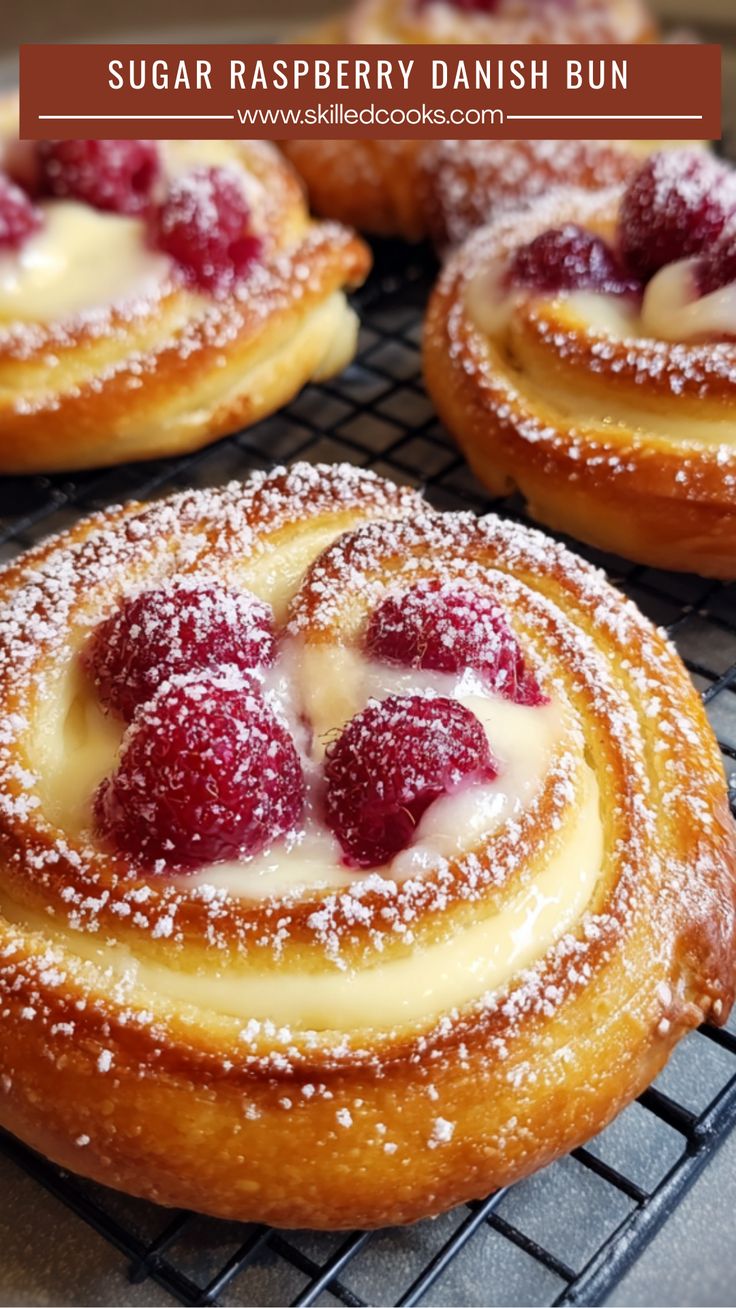
Step-by-Step Preparation
1. Make the Dough
Warm the milk until lukewarm and mix with sugar and yeast until dissolved.
Add the egg, followed by the flour, and mix until a smooth dough forms.
Gradually add butter and knead for 5–6 minutes.
Place the dough in a greased bowl, cover with plastic wrap, and let it proof in a warm spot for 1–2 hours until doubled in size.
2. Prepare the Custard
Heat the milk on low until it simmers.
In a bowl, whisk together sugar, cornstarch, vanilla paste, and eggs.
Slowly add the egg mixture to the simmering milk, stirring constantly until it thickens. (Check out custard-making tips for perfect consistency.)
Pour the custard into a tray, cover with plastic wrap, and let it cool.
3. Assemble the Buns
Divide the dough into small balls (70–80g each) and proof again for 40 minutes.
Press a cavity into each ball, fill with custard and raspberry jam, and brush with egg wash.
Bake in a preheated oven at 200°C (fan) for 15–18 minutes or until golden brown.
4. Add the Finishing Touch
Drizzle with a sugar glaze or dust with powdered sugar before serving.
With these steps, your sugar raspberry danish buns will be bakery-perfect!
Nutritional Information
Understanding what goes into your pastry is vital, especially for health-conscious bakers.
Calories: Approximately 250–300 per bun (depending on portion size and toppings)
Macronutrients: A balance of carbohydrates, fats, and protein from the dough, custard, and filling
Allergy Info: Contains gluten, dairy, and eggs. Substitute with gluten-free flour or dairy alternatives if needed.
Cultural and Historical Context
The sugar raspberry danish bun is part of a long and flavorful tradition that dates back to the 19th century, rooted in Denmark’s proud baking heritage. Danish pastries, known locally as “wienerbrød” (Viennese bread), originated from Austrian bakers who brought their techniques to Denmark in the 1850s. Danish bakers adopted and perfected these methods, creating their own distinctive pastries layered with butter and enriched with custards, jams, and glazes.
The evolution of the sugar raspberry danish bun reflects this rich history. The combination of a sweet yeast dough filled with tangy raspberry jam and creamy custard showcases the creative spirit of Danish bakers. These pastries were originally crafted for special occasions, such as celebrations and holidays, but their irresistible appeal quickly made them a daily treat in bakeries worldwide.
The rise of Danish pastries globally was solidified when Danish immigrants brought their recipes to other countries. In the United States, for example, these treats became synonymous with indulgent breakfasts and coffee breaks. Today, variations of the Danish bun, featuring local ingredients and flavors, can be found in almost every corner of the world.
From the Berliner in Germany to croissants in France, the influence of Danish pastries is undeniable. However, the sugar raspberry danish bun remains uniquely Danish, characterized by its balance of sweetness and tanginess, as well as its decorative appeal. Its flaky, buttery layers and jewel-like raspberry filling make it a true feast for both the eyes and the palate.
For a deeper dive into the origins of Danish pastries, explore the fascinating history here. This pastry’s journey from Austrian influence to a global favorite is a testament to the innovation and skill of Danish bakers who turned simple ingredients into culinary masterpieces.
Serving Suggestions
Enhance your pastry experience with these simple serving ideas:
Pair your sugar raspberry danish bun with:
A hot cup of coffee
Herbal tea with a hint of lemon
Decorate with:
A drizzle of royal icing
A dusting of powdered sugar for a classic finish
ADVERTISEMENT
